What Killed the Microphone Dinosaurs?

The 1970s saw a mass extinction of British companies that produced ribbon microphones.

Dinosaur with microphone running from  a meteor strike
Don’t look up!

At the start of the 1960s there were at least seven significant and well established makers of ribbon microphones in the United Kingdom: Cadenza; Film Industries, Grampian, Lustraphone, Reslosound, ST&C, and Tannoy. Some of these companies like Reslo and ST&C had been in the business of producing microphones since the 1930s, yet by 1980 all seven had either ceased trading, sold their interests, or abandoned the market to focus on other products.
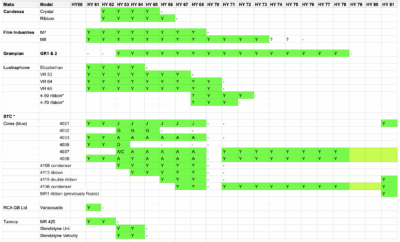
Timeline of British Ribbon Microphones ’60-’81

Tannoy stopped making ribbon mics in the early 1960s but continued to produce speakers and public address systems with such success that they became a household name – synonymous with unintelligible announcements at railway stations throughout Britain. SimonSound, who made the Cadenza microphones, disappeared in 1967. Perhaps the booming home recording market was already saturated at this point, and Cadenza was undoubtedly had the weakest design – evolutionary forces dictated that it would not survive. Similarly, Lustraphone had to all intents and purposed ceased making ribbon mics by 1971 – some new models such as their mythical 4-50 model were promoted but never appeared, and the company had vanished completely by 1973. Film Industries soon followed in around 1974 – their M8 models had been sold unchanged since the 1950s. Reslosound thrashed around for a few years, spitting out various new dynamic models, a new logo and even a condenser microphone. They finally ceased trading in 1978. Grampian hung around for another year before extinction.
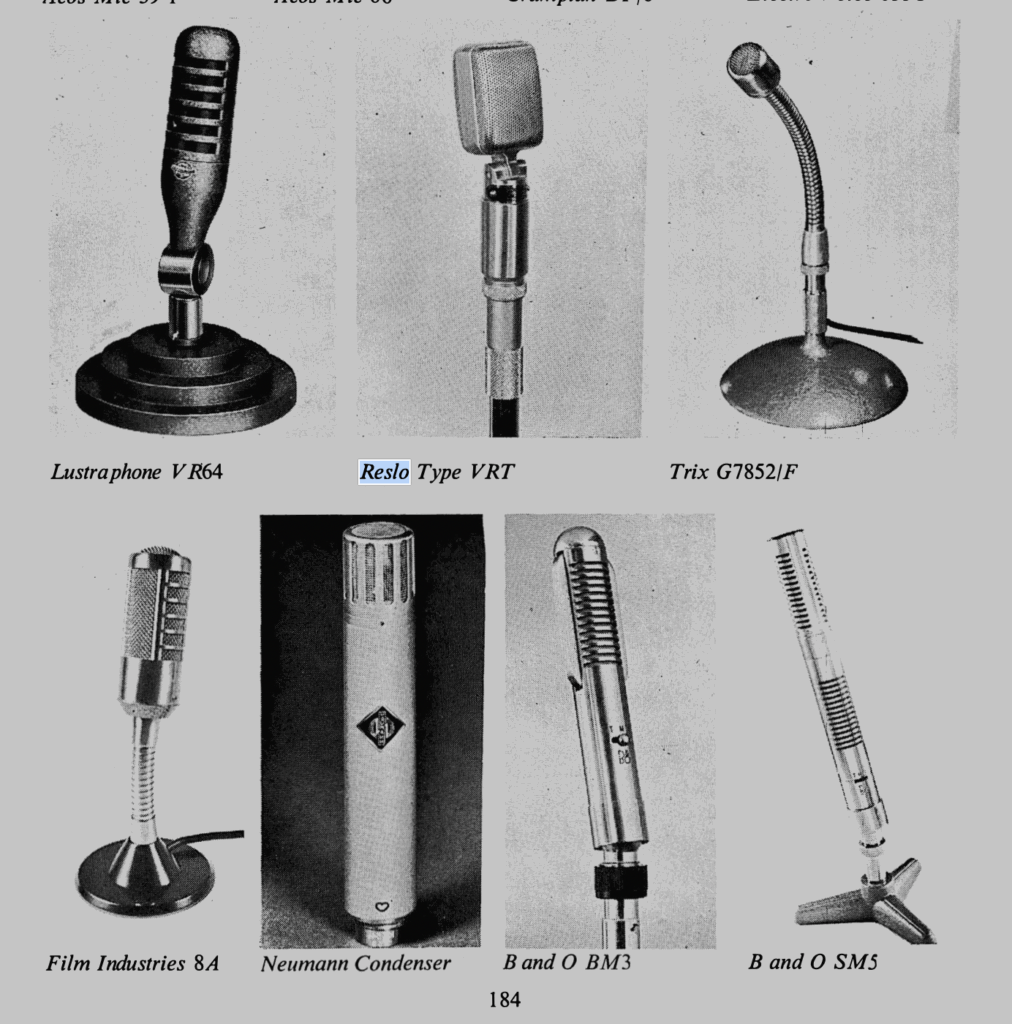
British Ribbons and other models

So what happened? The British economy faced severe challenges in the mid 1970s, which led to a deep recession. Oil prices were sky high due to conflict in the Middle East, which was compounded by the Miners strike. This led to rampant inflation, power cuts, and a three day week for many workers to save electricity. The knock-on effects of this were high unemployment and reduces consumer spending.* It took nearly four years for the UK’s GDP to recover back to pre-1973 levels.

Arguably, some British manufacturers had not invested sufficiently in product development and were still selling the same technology that they had developed in the late 50s or early 60s. For example Film Industries M8, Lustraphone VR64, Reslo RB and Grampian GR1 were all essentially unchanged from 1960 through into the early 1970s. Meanwhile, new imported models from Shure, Neumann, Beyer and others were smaller, lighter and had better signal to noise and frequency response. And these new mics came with standard XLR or DIN plugs, which meant that the user did not need a different cable for every microphone. This combination of recession, reduced consumer confidence, and high quality imports squeezed the last breath out of the British ribbon microphone industries.

Did ST&C see this coming? They sold their microphone division to ITT in 1971, and then on to Coles Engineering in April 1974. Coles are still making the classic 4038 and other microphones to this day. Perhaps their focus on professional studio and broadcast rather than home taping made them more secure than others, and their contracts to provide the 4038 and commentator mics to the BBC surely helped.

There has been a resurgence in ribbon microphone technology since the late 1990s. We started Extinct Audio in 2017, and are (perhaps) the first new company to make ribbon microphones in England since the 1970s. I guess we had better keep innovating – you never know when the comet is coming for you!
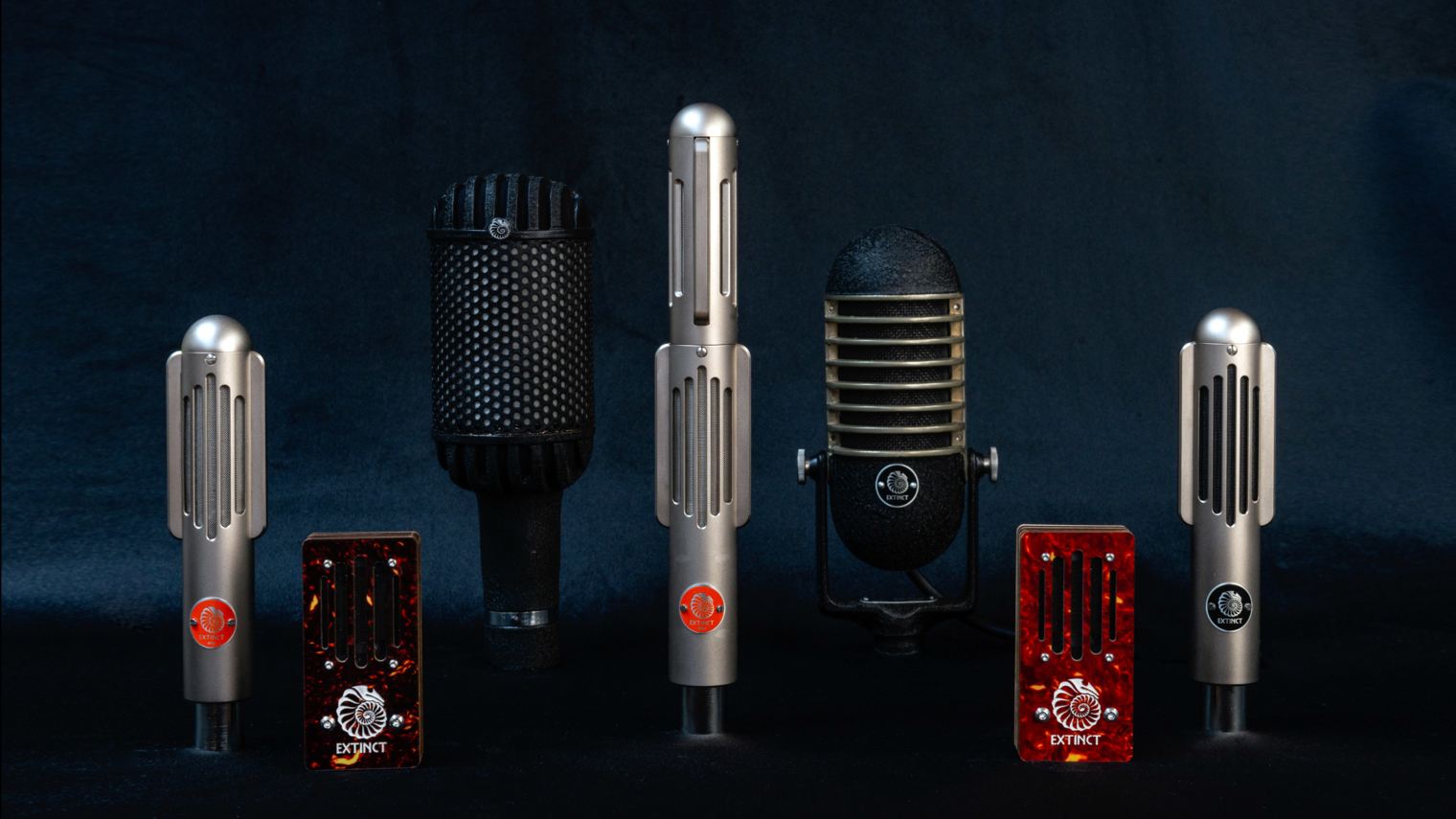
The Extinct Audio range of ribbon microphones – 2025

*Yes we are still talking about 1975 and not 2025!
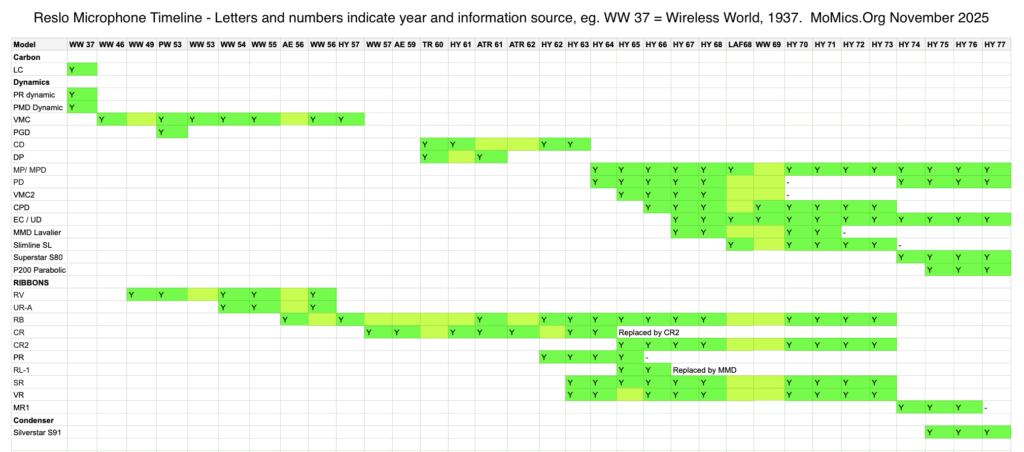
Reslo Timeline – when were which mics made?

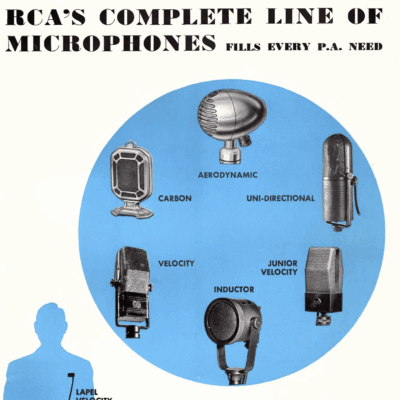
The Reslo microphone lineup from around 1967

Reslo, a.k.a. Reslo (Sound) Ltd., a.k.a. Reslosound, was a British manufacturing company who made audio equipment and produced A LOT of microphones between about 1937 and 1978. In just 40 years they went from making primitive carbon button style mics through ribbons to modern looking electrets and handheld dynamics. In the middle were the ribbons that we associate with the brand, including the RB and CR models used by a well-known beat band from Liverpool. 🙂

Reslo mics are by far the most popular brand that we see in for service at the Xaudia workshop, and I probably work on a hundred or more Reslo mics each year. The RB model is the commonest, making up perhaps 90% of those that come in for repair or for our popular Beeb (BBC) upgrades.

Although we have good documentation for many of these microphones, most of the original manuals and promotional material are undated, so we have to work a bit harder to find dates for Reslo products.

I have attempted to summarise when the Reslo models were made by trawling through numerous old magazines, looking for advertisements and reviews. The nice thing about magazines is that the issues usually have dates, which gives us a snapshot of which microphones were available at that point in time. Wireless World and HiFi Yearbook proved especially helpful.* The results are in the spreadsheet below – we may have missed a year or two either side, but these dates are broadly accurate to the best of my knowledge. Information before about 1960 is scarce and should be considered less reliable than that for later models, and we have almost nothing from the wartime years from 1939 to 1945. Additional documents may come to light in the future which can expand our time line. Let’s hope so!

Timeline for Reslo microphone models. Click it for the full size PDF version.

The earliest models appeared around 1937 and include the LC, a carbon mic, and two dynamics, the PR** and PMD. By 1946, with a world war in between, these three models have vanished and the VMC dynamic mic has appeared.

We can see that the RV ribbon microphone was available from around 1949 through to the mid 1950s, when it was superseded by the hugely successful RB and related models (including the SR1 and VR), which were in production until 1973. The end-address CR model (which is really just an RB in a different shell) was launched around 1959 and received a face-lift in 1965 to become the CR2. Amazingly, the VMC and VMC2 dynamic microphones were in production right up to 1968, by which point these heavy paper cone dynamics were very old technology and sonically no match for an imported shiny new Shure or Neumann!

In hindsight, 1973 looks like a year of revolution at Reslosound, with many of the old models, including the RB and CR series, being retried. Several new dynamic models were launched, along with a new logo and even an electret condenser for the first time. The only ribbon microphone left in the 1974 line-up was the MR1, which used a repackaged RB motor with a smaller transformer. I surmise that they were trying to modernise their range to compete with imported mics from Germany and the USA.

Hello John, got a new logo?

But it didn’t work. Sadly, by 1978 Reslo had ceased to exist.

*World Radio History website is an invaluable resource for searching old audio publications.

** They later recycled the PR name for the Pencil Ribbon which appeared around 1962.

Thanks to Sam Fitzgerald Kay and Marco van der Hoeven for their help in compiling this information.

RCA microphone MI numbers and catalogs

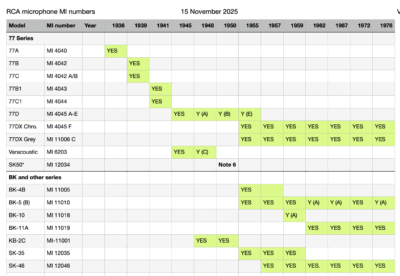
You may have noticed that many RCA microphones have (at least) two names. Generally they have a model number with one or two letters before or after the number, for example 44BX or KU3A. But all RCA products also have an MI number, which is short for Master Item.* The MI number is usually four or five digits and may or may not be followed by a letter, and may contain extra information such as minor improvements or a different finish. A major change might involve a whole new number For example a shiny black and chrome RCA 77D is MI-4045-E and the improved 77DX is MI-4045-F. However the broadcast grey version of the 77DX was considered sufficiently different to become MI-11006-C.

I took a little tour through some old RCA product catalogues and attempted to correlate the microphones’ common names with their MI numbers, and track any minor revisions across the years.

The full document can be downloaded here as a PDF.

The 1930s saw a rapid development in ribbon microphone technology but documentation from that era is hard to find. (That is a big hint – if you have any old RCA catalogs then please share them widely). We have a 44A manual from 1933, and by 1936 the early PB series and related microphones were already being phased out, with only PB90 left in the catalog The longevity of the 44B/BX and 77D/DX models is notable but expected, with each being in production for around 20 years. Other models appear only fleetingly – the 77B and C models appear only in 1948, and the B1 and C1 only in 1950. Some models such as the SK-50 and KU2 do not appear in any of these documents.

From 1968 onwards RCA introduced a new look, retiring the old red meatball logo in favour of a three letter graphic with a modern stylised font.

RCA logos – from 1000logos.net

If you have any further information or dated documents to help improve this work then please get in touch. Thank you.

* I have seen MI called Master Index in places, but the RCA catalogs call it Master Item, so let’s go with that!

** British spelling. RCA use the American English “catalogs”