The Xaudia Blog

Recording with the Josephson C720

Back in August we were lucky enough to get our hands on a special edition Josephson C720 microphone for the studio, one of only 20 made in the first production run, and having lived with this for nearly half a year it’s probably about time we reviewed it.
josephson C720 microphone
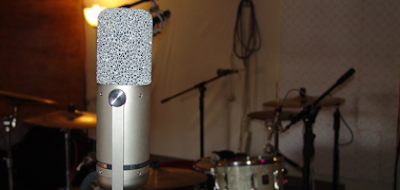
The first thing you notice about the C720 is its size – this is one big mic, U47-big, and makes a big bold statement in the live room or vocal booth – it’s built like a tank and it definitely has that ‘wow’ factor which gets the artists talking.
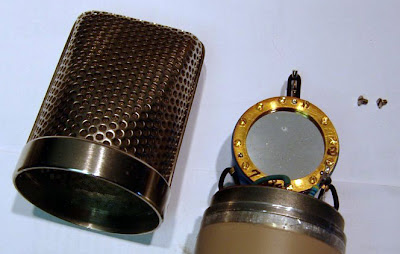
The next thing that grabs your attention is its radical aluminium metal-foam headbasket, which looks like something you could scrub your pots and pans with. The non-periodic headbasket is actually designed to eliminate internal acoustic reflections and refraction of soundwaves, avoiding comb-filtering effects and so giving a more realistic recording.
The third thing you notice is that it has two XLR outputs. Like many condenser microphones, the capsule has dual diaphragms which can be combined in different combinations to give cardioid, omni, figure of eight patterns. Unlike most microphones, the two transducers have separate head amplifiers and separate outputs which means that the signals from opposite sides of the microphone can be recorded separately and mixed together, either in phase or with the polarity reversed, at a later stage. What this innovation means in practice is that you can pick the polar pattern after recording, which might be used to eliminate unwanted sound sources by rotating the null point of the microphone. Also, and more importantly in our studio use, with close-mic’ed sources such as vocals you can dial in more or less proximity effect, making a singer seem bigger, darker or lighter and brighter.
So what does it sound like? Possibly because of the lack of head basket comb filtering, and the facility to tune the pattern and proximity effect, this is a very versatile microphone. The one word that sprang to my mind in describing the sound, whichever pattern you pick, is ‘solid’.*
Another thing we’ve noticed is it sounds pretty damned good on pretty much anything you can throw at it. Because of it’s ability to handle high sound pressure levels and become a go-to mic for low end stuff, and is rock-solid on bass guitar and front of kick drum, but it’s just as handy on both male and female vocals – especially those with a tendency to get loud when they belt it out. Vocal recordings are up front, sound as they should, but without the top end brightness of, say, our TLM49.
Furthermore, it can be used for more radical effects by compressing or reverberating one side of the capsule only. For example, I had some interesting results on a male rock vocal by compressing the signal from the front capsule, mixing together with the phase reversed rear capsule, then compressing the sum of these. The effect was that as the vocals push harder, the relative amount of rear capsule included becomes greater giving it more of a hypercardioid pattern, balancing the tendency of the vocalist to step back from the mic when belting it out. With a bit of creativity the possibilities are endless.
Overall this is a brilliant, radical piece of thinking and and one of those bits of gear that comes into your life and is there to stay.
*After writing this I read another review of this mic which used exactly the same word – ‘solid’ – to sum up the sound.

New Toy!

AVO MkIII tube testerHere is our new pride and joy – a 1960’s AVO mkIII valve characteristic meter. It’s built like a tank, with wonderful vintage knobs and dials. And comes in handy for getting those amps and mics up and running.

Framus Television

Framus Television

It is quite sad to think that the success of the big American guitar manufacturers (F–, G–, you know who you are!) led not only to some excellent instruments and high standards of construction, but also to the demise of several smaller builders of quality guitars. Cheap imports from the East added to the problem. One such victim was the German manufacturer Framus, who went bankrupt and ceased production at the end of the ’70s. (The company has since been reborn).

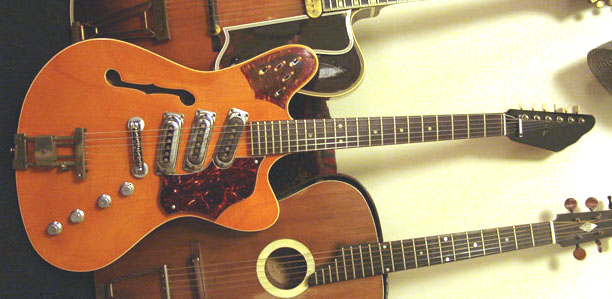
Framus made guitars of generally high quality with some interesting features. Here is a 1968 Framus Television semi-acoustic, the shape of which is clearly influenced by Fender’s Jaguar/Jazzmaster (or was it the other way round?) . It has a pleasing asymmetry, with a single f-hole (as far as we can tell, most Televisions had two), three pickups, and a tremolo. The headstock shape is whacky – like a big hand – but we like it. Colour of this one is a beautiful stained carrot-orange-yellow, rather like certain Gretschs – we think they call this ‘aniline yellow’. It has a laminate top and back.

This guitar arrived on the bench with toggle switches in place of the original sliders, as well as a couple of loose wires, which we of course replaced/fixed. The circuit is slightly unusual (which is why it is on this website at all!), so we’ve sketched a circuit diagram to help other owners.

Framus Television circuit

The circuit consists of two parallel output stages each with volume and tone pots (marked T&V in the diagram) , which the player may use to switch between ‘rhythm’ and ‘lead’ settings. This approach predates the days when everyone has booster pedals on the floor, and similar systems are also found on Jaguars and Jazzmasters. In the ‘rhythm’ position, only the neck pickup is active. In the ‘lead’ position any combination of the three pickups may be switched on – the pickups in combination give some audible phase cancellation. There is also a bass cut filter switch. A summary of the switches:

S1 = Bridge pickup on/off
S2 = Middle pickup on/off
S3 = Neck pickup on/off
S4 = Bass cut (lead circuit only)
S5a = Sends neck pickup to rhythm or lead tone/volume circuit.
S5b = Switches between lead and rhythm tone/volume circuits.

As the tone and volume pots are tricky to remove and function well, they were not investigated or measured for value. I think they are just standard.
There’s a good chance that the circuit is similar to Strato Delux models of similar vintage, which also have up to 5 switches. Do let us know if you can confirm or deny this.

G7 microphone

Jakob Erland’s Gyraf G7 DIY tube mic project has proved one of the most popular microphone projects. Several years ago I built a pair of these from scratch, and have since built several variations using different tubes, transformers etc. Below are a few notes on the project.

1. Using a single sided capsule

When using a single sided capsule, the circuit can be simplified somewhat and several parts omitted. The capsule may be wired straight to the tube grid, avoiding use of a coupling cap. Note that this affects the polarity of the mic, so reverse the output wires and be sure to check against an SM57 or similar know microphone. In this arrangement, the backplate polarisation resistor can be lower than 1 gig.

2. Some measured voltages:

I built a version of the microphone by etching Gyraf’s layout. Wired it up and checked some voltages – and found that the supply is rather low under load. I got about 176 Volts without the mic connected, and was down to 136 V with the mic in the loop. Heater supply dropped from 6.3V (set whilst unloaded) to 6.08V. Here are some voltages for reference.

3. Better matching of the capsule polarisation voltages.

Note in the diagram above that one side of the capsule has a slightly higher voltage than the other – no problem in omni or cardioid but noticeable in figure8 mode when recording Blumlein pairs. Here’s a quick fix!